

Watching the news, reading books about Racism, Anti-Racism, and consuming anti-bias trainings, I often walked away with a resounding question: What on Earth is going on with White people?
Maybe you, dear reader, have had the same question. While I have learned (and am learning still) all the intersecting factors that result in racism as we see it today in America, this book answered the core question: What is wrong with White people?
It turns out, it’s what’s wrong with all of us.
The Anti-Greed Gospel, written by Malcom Foley, dives deep into the simple but true origins of racism as we experience it today. Greed. It seems too simple, but this is probably because it’s hard to accuse our culture’s best friend, the god of overconsumption: greed. Greed is “when desire outstrips need” (Foley, pg. 17). In a world heating up under the pressure of our consumption, it’s hard to argue that greed has its talons in each of our lives. Looking at my own budget, ripped to shreds by impulse spending, comparison, and other aptly named talons of greed, I find myself trapped.
Racism as a Justification of Greed and Exploitation
Foley argues that racism is not simply a problem of lies, because if it were, telling the truth would rectify and reunite humanity. We only need to look around to see that this hasn’t worked. Why? Because racism is a justification for greed and exploitation.
Racism as a result of the love of money makes more sense than simply believing a lie over generations. Foley describes the arrival of racism as a process called the Cycle of Self Interest (pg 35):
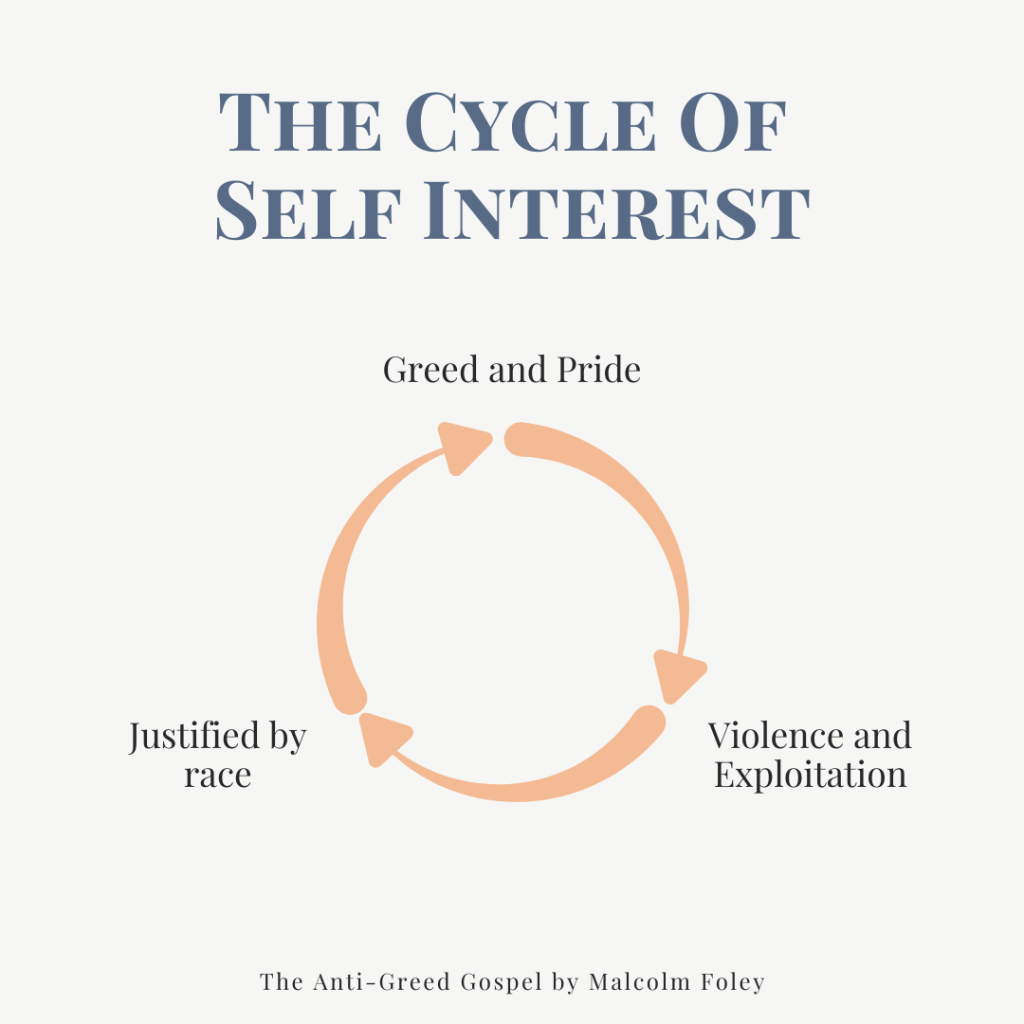
Put simply, white people became racist not because they were ignorant but because it benefited them to.
Foley uses the horrifying history of lynchings to illustrate how what outwardly appeared to be racially motivated violence was, in fact, most commonly generated through economic self-interest.
So what do we do in response? How do we tackle racism in our country, or in any place for that matter? When racism sprouts, we can dig it up by its roots, or cut off branches and wonder why it still springs back. One is by far much easier and more comfortable. The other requires us to get our hands dirty, which is what Foley outlines for us to do. To dig out the root of racism that is choking our communities, we need to do 3 things:
Create communities of “deep economic solidarity”
Communities are where we live out the command to love your neighbor, a directive from God throughout the Old and New Testaments. Apparently, Jesus saw the Israelites failing in the area of loving our neighbor when it comes to money, as he discussed money more than any other topic. Yet we rarely talk about it. Foley states, “the more you have and hold, the less you love your neighbor,” echoing the haunting words of St. Basil, “The more you abound in wealth, the more you lack in love.”
Thus, to dismantle racism in our communities and take a stance of standing with, rather than paternalistically “giving,” Foley says we need to remember that “the greatest return on our investment comes from our investment in the poor.” This eternal ROI is the result of seeing our impoverishment as God’s people, his children, our family, rather than simply viewing through the eyes of the stock market.
Create communities of “creative anti-violence”
In his book, he calls out the most prominent examples of violence on the planet, as poverty and war. Poverty surprised me, especially as a history buff of World War II. Still, the reality is that poverty has devastated the earth far more pervasively than war has. We allow poverty to exist in the US, yet boast that we have little experience with battle on our soil since the Civil War.
Yet anti-violence does not equate non-action. We must act, and act creatively. Foley also states that “An anti-violence ethic is an ethic of suffering” (Foley, pg. 137). Not exactly a happy promise, but a realistic one. How comfortable are we? If we are comfortable, can we accurately sing out that we are doing anything? Or just thinking about maybe doing something?
Create communities of “prophetic truth-telling”
Anti-racism does involve a dismantling of harmful and grossly incorrect narratives. We must speak out against the lies that ultimately come from the pits of hell and actively tell the truth. Yet we must remember that, again, we resist not just with our words, but also with our actions and our money. “Race is a lie that keeps us from seeing our neighbors as neighbors,” he says. In a meritocracy rigged by racism, race is used to qualify people as deserving and not-deserving, or that is “my neighbor” vs “not my neighbor.” But this is where many people stop, thinking that hanging out with someone of another race equals anti-racism. Foley counters, “The goal is not just to avoid being racist. The goal is to drain race of its power… the goal is that no person is a victim of injustice” (Foley, pg. 142).
This book contains numerous additional insights and details that cannot be covered in this brief blog post. For example, details are provided about three critical figures in the anti-racism movement, including Ida B. Wells, a pioneering journalist and activist who fearlessly exposed the horrors of lynching. Their stories serve as powerful examples of courage and resilience in the face of racial injustice.
Read this book; it’s a quick read that has the potential to transform your perspective and deepen your understanding of how we arrived at our current state. It’s a journey worth taking.

 Dani's Diary
Leave a comment